Natural history essay, January 2026: Iridescent dancers
Published 1:30 am Thursday, January 8, 2026
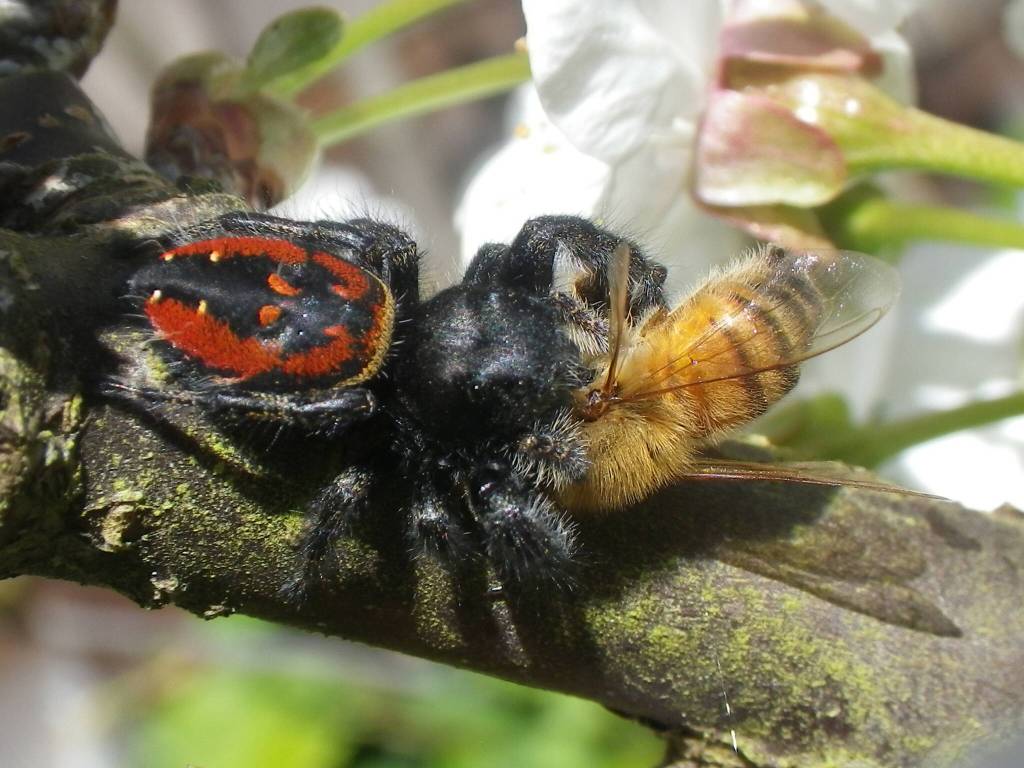
by Russel Barsh
Director of Kwiaht
What has eight eyes and stalks its prey like a cat? It’s not a weird science fiction monster; only a small, frequently overlooked spider that is native to the San Juan Islands and relatively abundant around the Salish Sea: the red-backed jumping spider, Phidippus johnsoni.
Jumping spiders (family Salticidae) are exceptionally successful and diverse worldwide, with more than 6,000 described species, or nearly one-eighth of all known spiders. Their acrobatic leaping, which can exceed 20 times their body length, is equivalent to an average-sized human vaulting about 100 feet. What distinguishes them most from other arachnids, however, is their extremely fine color vision, which evolved about 55-60 million years ago after the demise of the non-avian dinosaurs and consequent rise of birds and mammals.
Unlike the compound eyes of most insects (and crustaceans), jumping spiders have evolved eyes that are similar to those of humans and other vertebrate animals. They are camera-like, with a corneal lens and a retina carpeted with three kinds of color receptors. And yes, there are eight of them: two large principal eyes in front, and three smaller lateral eyes on each side of the head. The row of lateral eyes enables the spider to detect and measure motion, turn and focus its pair of primary eyes on the target. Experimentally, jumping spiders tend to identify prey by the ways they move more than their shapes; then they rely upon binocular vision to judge distance before they leap. Experiments with jumping spiders have also shown that their eyes are unusually sensitive at low light levels, so that they have an advantage — like cats — when hunting at dusk or in twilight.
Indeed, while some species of jumping spiders set silken traps that they can use to jump-ambush prey, others have been observed engaged in cat-like stalking of other spiders, as well as crickets, aphids, ants and harvestmen (Opiliones). Another talent of salticid spiders is leaping from a leaf or branch and snatching a fast-moving flying insect. Like other spiders, salticids have venomous claw-like chelicerae that can instantly subdue potentially dangerous prey such as a bee, wasp or another spider.
In spring, each female Phidippus weaves a silky tube extending deep beneath a tree root or inside a rocky crevice to serve as her nest. Occasionally, a male will enter the nest and seek permission to mate by gently touching the female and vibrating. More often, it appears, males will encounter females while hunting, and do a little dance, waving their legs and prancing back and forth, as a message that they are interested in sex rather than a meal. (Recall that salticid spiders are most visually sensitive to motion.) Females only rarely attack and eat dancing males. Most often, they accept the proposal, copulate and return to their nest to deposit some fertilized eggs.
Among Phidippus, a female may mate with several males over the course of a summer and lay a number of clutches of fertilized eggs in her nest. But a successful male tries to gain an advantage for his offspring by plugging the female’s epigynal orifice so that, for a period of time, she cannot receive sperm from any other male. This controls the number of times females can mate before they either die or overwinter for a second reproductive year.
It is unclear why jumping spiders tend to have brightly colored body parts, including blues, reds, greens and yellows, often metallic or iridescent. Phidippus johnsoni has a conspicuously scarlet-colored abdomen. Some researchers have suggested that this is protective mimicry, making the spider look like the hairy red “velvet ants” (actually Mutillid wasps) that share much of the same geographic range in North America, including Vancouver Island and eastern Washington. Mutillid wasps do have a nasty sting. And while salticid spiders have venomous “bites” of their own (potentially painful but not dangerous), they tend to flee rather than engage a threatening larger animal, such as a curious entomologist!
Another possible explanation of salticid colors is an adjunct to motion in communicating species identification to potential mates. Males are typically more brightly colored than females, and this species-specific signal is conspicuous when males are dancing.
Our red-backed jumping spiders are typically only about a third of an inch in length, so you must look closely to see their short stout legs and bright dark eyes. If you are lucky enough to discover one in your garden — or perhaps clinging to your jeans after a hike through tall grasses or shrubs — it will likely turn to look at you and squat down in a crouch, ready to leap out of your grasp!