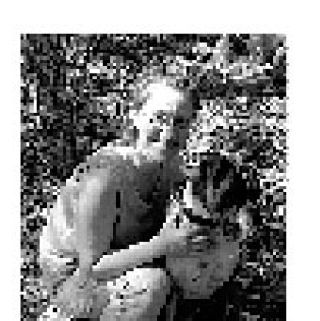
Early in Niki Becker’s education as a physician, she learned a lesson familiar to most medical students: If you hear hoof beats, think horses, not zebras, because the most common explanation is usually the correct one.
Unfortunately for Lopezian Niki Becker, M.D., she is a zebra.
At age eleven, while practicing the breast stroke in waist-deep water, she dislocated her shoulder. Thirty years later and after countless dislocated limbs and digits, several surgeries, and even questions about her sanity from many in her own profession, a surgeon insisted that she see a geneticist. It was this visit which provided her with the diagnosis of Ehlers-Danlos Syndrome (EDS), a condition about which less is known than the dark side of the moon.
When asked to explain what EDS is in terms a lay person could understand, Dr. Becker smiles and said, “It’s a defect in all the ‘stretchy’ things in the body.” My vacant look prompts her to continue. “EDS is a defect in the body’s connective tissue, specifically collagen or some protein related to collagen. Everything from ligaments attaching bones to other bones to collagen within the blood vessels themselves is affected.”
“If you consider a condition that causes the ‘stretchy’ things in the body to be too loose, as well as making them excruciatingly painful, you have a good beginning understanding of EDS.”
The question of EDS’s prevalence is more problematical. Because it is so widely mis- and underdiagnosed, its exact numbers are unknown. This lack of an accurate diagnosis is particularly devastating for the young sufferer.
When asked how EDS impacts her life today, Dr. Becker says, “An important part of my EDS is Postural Orthostatic Tachycardia Syndrome (POTS), which means that if I stand up fast, especially when it’s hot, I’m apt to find myself lying on the floor. Heat is also a real enemy, which is a large part of the reason I moved to Seattle and Lopez. Baths and massages are out, as are most sports cars, because of their bucket seats.”
The list of problems grows progressively more serious when the subject of pain is introduced. “Most available pain medications exacerbate my problem. Also, while an X-ray of my left hip—the largest source of my current mobility problems—shows the hip of a 26 year old, my mobility issues and pain are those of an 86 year old though I am only 46. Additionally, my risk for fracture is that of an 86 year old.”
At this point in the interview, Dr. Becker’s voice softens almost to a whisper. “Five years ago I was working around 100 hours a week; I was a full-time clinician, deeply involved in the emotionally and physically challenging work of Pediatric Nephrology and Adolescent Medicine. I kayaked, hiked, and read extensively. Today, I can’t get my own firewood, walk my dog, Cooper, for more than a block, can dislocate my shoulder simply by moving the shower curtain, and have had to stop practicing medicine b
ecause of the fear that the distraction of my EDS pain could one day negatively affect a patient.”
When asked what she would want everyone to know about EDS, Dr. Becker says, “It exists. It needs to be treated; it is not in our heads. Kids with EDS deserve a better life than I have right now. People must become aware of it or we will never be able to do anything about it. Chase Community Giving is allowing users of Facebook or Twitter to influence the awarding of $1,000,000 to a cause based on an internet vote. EDS made the top 100 causes in the first round of voting, so we’re trying to get votes between January 15 and January 22, 2010.
Because NIH funding has been growing more difficult to obtain the past few years, the money Chase Community Giving is making available is that much more precious. To vote, Facebook users should go to: http://apps.facebook.com/chasecommunitygiving/charities/235097; Twitter users should go to: http://twitter.com/#search?q=%23chasegiving. There is no charge for voting, but doing so can contribute to beginning the awareness necessary to change to lives of “zebras” everywhere.