
By Darrell Kirk
Sounder contributor
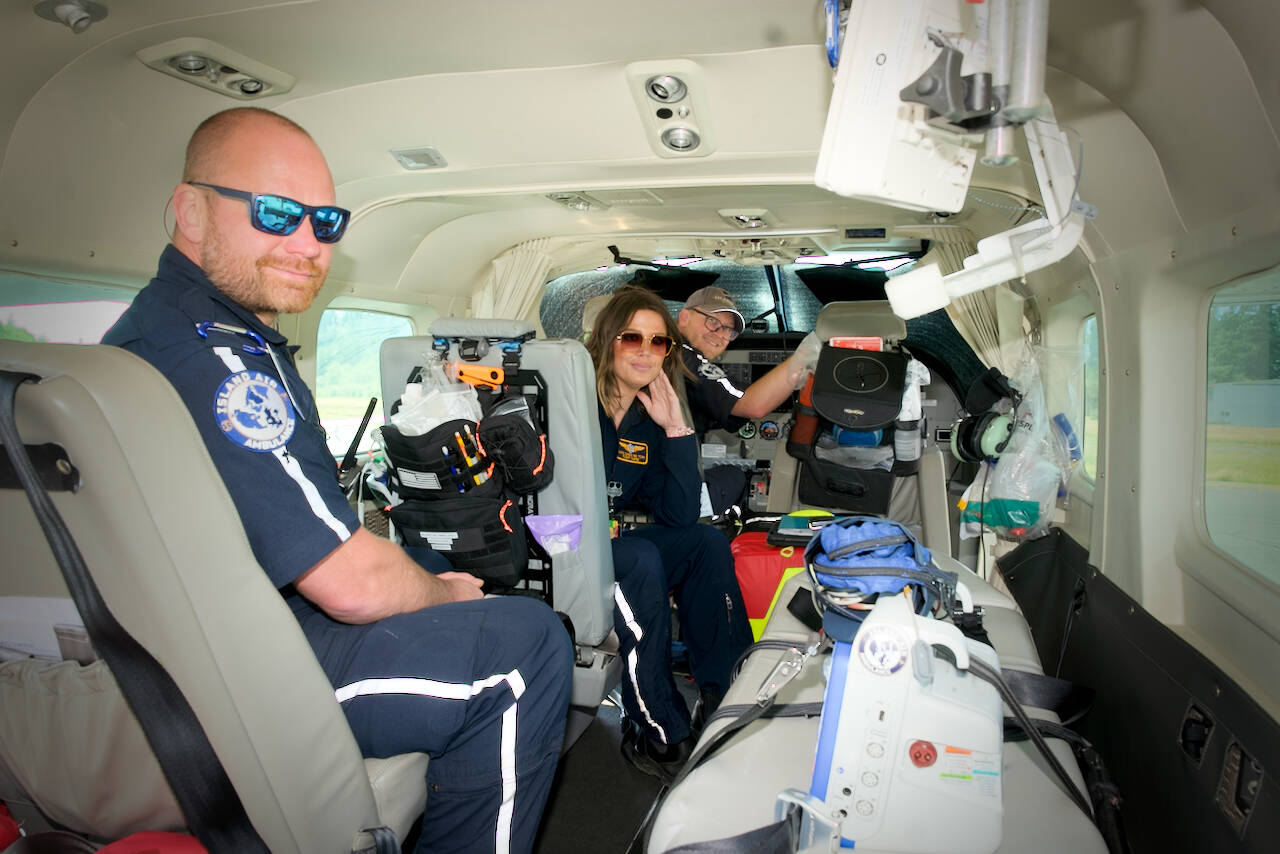
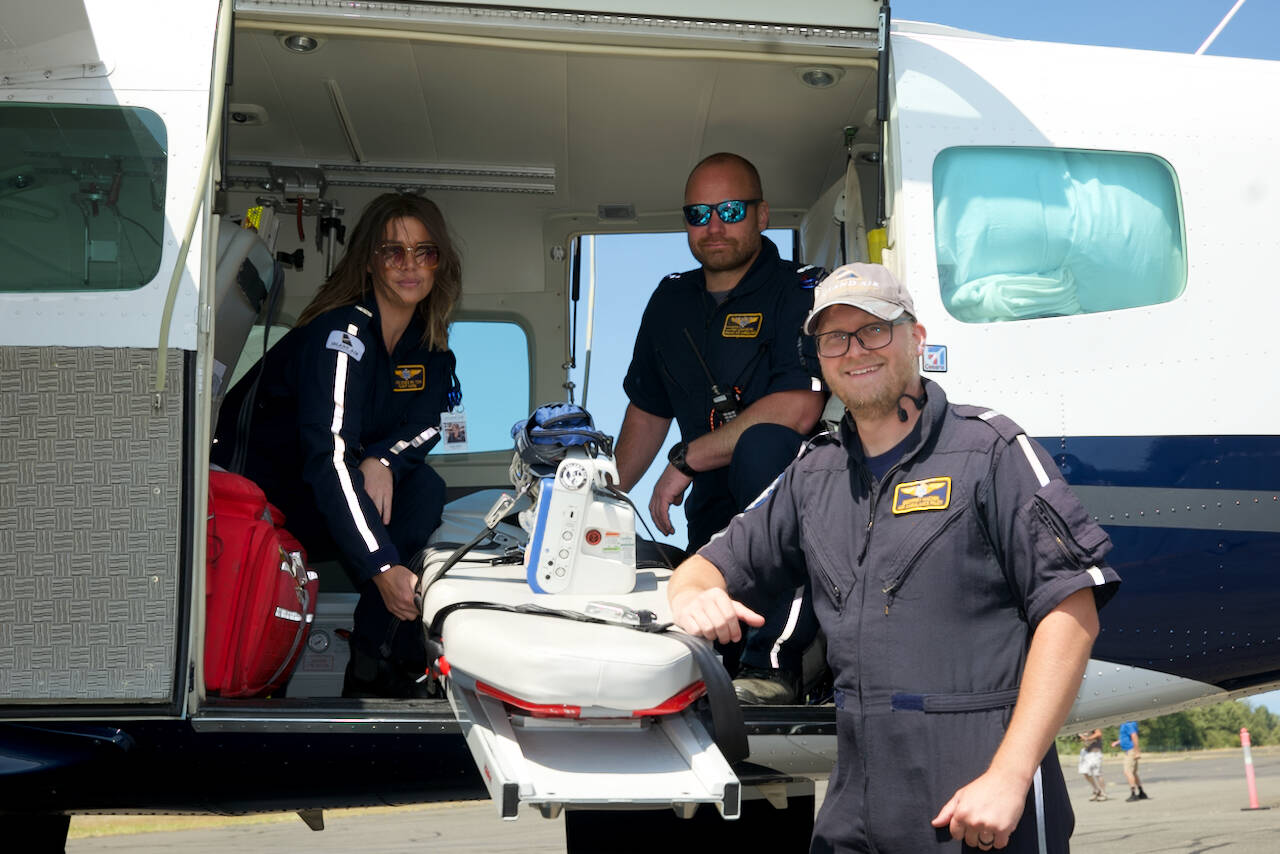
During the recent Orcas Island Fly-in event, I caught up with the dedicated team at Island Air Ambulance to learn about their critical mission serving the San Juan Islands. Remarkably, they were called out for an evacuation after our interview, demonstrating the constant readiness these professionals maintain.
A legacy born from community need
Island Air Ambulance has deep roots in the San Juan Islands, tracing its origins back to the pioneering work of Roy Franklin and Dr. Heath in the late 1940s. “In fact, fixed-wing medical transportation off of the islands really began with Roy Franklin and Doc Keith back in the late 1940s. So we’re just kind of the third generation of what’s been going on in the islands for a long, long time,” explains Will Hamilton, whose wife Jackie Hamilton founded Island Air 33 years ago.
Will recalls the humble beginnings with admiration: “I remember when it was her and her golden retriever and her mom and dad in a Cessna 172 in the Friday Harbor Airport over 30 years ago. And what she’s built is something that I’m very proud of.”
Jackie’s entry into air medical services began 25 years ago when she became involved as the fixed-wing backup to the MedFlight helicopter based in Bellingham. “There was a fixed-wing backup to the MedFlight helicopter, and she got involved probably 25 years ago being the backup for the helicopter in Bellingham,” Will explains.
From those modest beginnings, Jackie has built what Will describes as something remarkable: “She’s transported thousands of Islanders and I’m proud of her. And I’m also proud of our clinical staff and our aviation staff and now our maintenance staff. I don’t believe there’s another small organization like this anywhere in the United States.”
The company’s community focus remains unwavering. “We’ve had some opportunities to expand outside the community, but we’ve turned all that down because the San Juan community is our number one priority,” says pilot Jeffrey Machin.
The people: Dedication in critical moments
Flight nurses: Masters of airborne medicine
Katie Owens, a flight nurse who has been with Island Air since September 2024, brings extensive experience to her role. “I’ve been doing Medivac since 2016,” she says. Her path to Island Air came through connections in the tight-knit medical community: “We had a connection through Jason Heiner, who is our medical director, through mutual friends. It’s a pretty small community, so I heard of Island Air and was able to stay local.”
The qualifications for becoming a flight nurse are demanding. “Most medivac companies require a background in emergency services, so working in an emergency room, and then also coupled with experience in an ICU,” Owens explains.
Milo Lohman, another flight nurse with two years at Island Air, echoes the rigorous requirements: “You have to have some sort of past with ER medicine and stuff like that, ICU experience also.” Lohman’s commitment to the community extends beyond Island Air, as he works “at the hospital part-time in the ER in Friday Harbor, full-time with Island Air Ambulance, and then recently took on an in-home infusion job for Orcas Island.”
The variety of cases they handle spans all demographics and seasons. “It’s ages all across the span from newborns to, you know, labor delivery, all the way to geriatric,” Owens describes. “I think mostly on the San Juan Islands, we have a lot of folks who are geriatric, and so it’s a lot of strokes. It’s a lot of heart attacks. It’s a lot of infections or possible surgical services, and then in the summertime, there’s a lot of tourist activities. There’s a lot of boating accidents or water traumas.”
Working in the confined space of an aircraft presents unique challenges. “I think that we are all pretty used to feeling that pressure, so it’s just having that pressure, in a confined space,” Owens notes. “We practice a lot of scenarios actually in the aircraft itself, so we know how to maneuver about. You know, it is unique. It’s different from working in a hospital with an endless amount of staff members, but it’s something that is well practiced.”
The time pressure is intense. “For example, if we leave Friday Harbor for Lopez Island where an ambulance is waiting, it’s about seven minutes from engine start to landing,” Lohman explains. “From the moment we get in and start the engine to when we land and begin patient care, we only have seven minutes total. You have to prioritize everything quickly.”
During flight, the nurses’ focus varies with the situation. “Depending on the patient, if it’s a nice day and it might be something more routine, maybe you’re able to look around and see how beautiful things are,” Lohman reflects. “Other times, you have your face in a chart, working out medication calculations, preparing to intubate somebody, or adjusting ventilator settings. You might not even be aware of much beyond takeoff and landing—other than a bump in the air, you’re just focused on what you need to do.”
The pilot: Safety and service above all
Machin, the pilot, brings enthusiasm and expertise to his role. “It’s fantastic. I love working for Island Air. It’s a great gig,” he says. “Will and Jackie are fantastic people. They’re very community-oriented. They like serving the community here.”
The work schedule allows for both professional dedication and personal life balance. “The schedule is fantastic for me. I work five on, five off. I live on San Juan Island, and I’m home every night. It’s really hard to beat as far as pilot jobs go.”
Safety culture is paramount at Island Air. “We have a fantastic culture of safety where there’s no pressure ever to do anything dangerous. We have very strict rules on that regard. Pilots, final authority, so if I don’t feel safe, we don’t go. If any other group doesn’t feel safe, we don’t go,” Machin emphasizes.
The daily routine for air medical pilots differs significantly from other aviation work. “Working in the air medical field, we start our day by doing pre-flight planning for a flight that may not even happen,” Machin explains. “We plan for all possibilities throughout the entire region. We’ll plan our flight, do weight and balance calculations, and determine the range of patient weights we can accommodate.”
Weather monitoring is continuous. “We do our weather briefing at the start of the day, then check the weather periodically throughout the day to make sure we’re still good to go,” Machin explains. “We stay in communication with our dispatchers so they know if the weather’s good and we can respond immediately, or if conditions are marginal and they need to check our response times.”
The ultimate goal remains constant readiness. “We try to be as prepared as possible to respond promptly to any emergencies that might be occurring,” Machin states.
The aircraft: Perfectly suited for island service
Island Air operates two Cessna 208 Caravans, specifically chosen for their unique capabilities in the challenging San Juan Islands environment. “This is a Cessna 208 Caravan. It’s a G1000 panel with a TKS anti-ice options. So it’s really a very simple airplane to fly, all things considered, but very dependable, incredibly dependable,” Machin describes.
The TKS anti-ice system sets Island Air apart from other regional air ambulance services. “We’re equipped with TKS, which is kind of unique for air ambulance services around here, so in the wintertime, once the freezing levels come down, it’s dangerous to fly other aircraft, whereas the caravan is very safe in icing conditions. We have a system that essentially secretes antifreeze from the wings to get rid of ice on the airplane,” Machin explains. “There are weather conditions when we might be the only resource available to the county, and it’s always rewarding to be able to support the community with that capability.”
The aircraft configuration is specifically tailored for short-distance island hopping rather than long-range transport. “It’s a relatively straightforward airplane with fixed landing gear and no cabin pressurization, which is unusual for [a] fixed-wing air ambulance,” Machin explains. “Most fixed-wing air ambulances handle longer flights crossing mountains, going an hour or more from hospital to hospital, but that’s not what we do at Island Air.”
Instead, Island Air focuses on scene calls and quick hospital transfers. “We’re more scene-call oriented. We often take patients directly from local EMS and transport them straight to the nearest appropriate emergency room—which is Bellingham St. Joseph’s Medical Center 85% of the time,” Machin notes.
The cabin design maximizes both space and accessibility. “It’s got a roomy cabin with a very large cargo door opening. The square cabin design is really nice—you don’t get that in a pressurized cabin, which can be very cramped like in a PC-12,” Machin notes.
Redundancy ensures continuous service. “We have two aircraft—we keep the second airplane available for charters, but if we have any maintenance issues, we can quickly swap it into air ambulance configuration. We always have a top-condition airplane ready for ambulance service. That’s our first priority,” Machin explains.
Island Air recently achieved significant recognition for its operational excellence. “We were just re-accredited by CAMES. That’s the Commission on Accreditation for Medical Transport Services. And we’re accredited at the same level as any of the top flight air ambulance providers throughout the United States,” Will proudly states.
The company maintains its own maintenance operation, ensuring optimal aircraft condition. “We have just recently started our own in-house maintenance. We’ve got some good people on that front. I’ve never had any serious problems with any of the airplanes that Jackie keeps and maintains,” Machin confirms.
An integrated lifeline
Island Air operates as part of a comprehensive emergency response network. “We’re part of an overall system that includes Airlift Northwest. It includes Life Flight Network. It includes our Sheriff’s Dispatch. It includes the EMS agencies on Shaw, Orcas, San Juan, and Lopez Islands. It’s a really well oiled integrated system and Islanders should sleep well at night knowing that we have all of these resources available,” Will explains.
For island residents, accessing this critical service remains straightforward. When asked what citizens should know or do to help, Will’s advice is simple: “Call 9-1-1. They will tell you.”
The COVID-19 pandemic presented unique challenges and opportunities for Island Air. “COVID was an unusual situation for us, primarily because of our county’s older population and the fact that our residents took COVID very seriously. I think San Juan County was one of the safest counties in the United States during COVID, if not the safest,” Will recalls. “So consequently, we did a number of COVID transports, but far fewer than other places around the country.” He credits effective leadership during this period: “I give a lot of credit to our county health doctor at the time, Dr. Frank James. He was simply outstanding in caring for all of San Juan County.”
As Island Air continues its mission, the dedication of Jackie Hamilton remains the driving force. “I have a tremendous admiration and respect for Jackie. She’s been doing this a long, long time,” Will reflects. From humble beginnings with a golden retriever and family support to a fully accredited air medical service, Island Air Ambulance stands as a testament to community dedication and the power of one person’s vision to save lives across the San Juan Islands.