

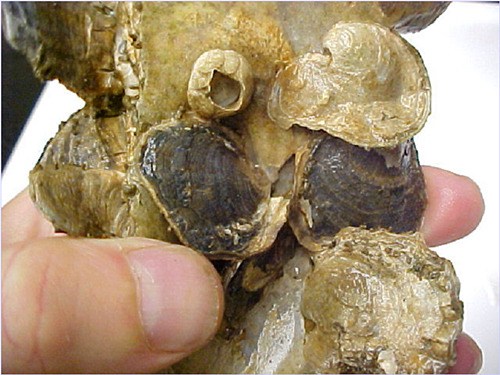
Kwiaht researchers have relocated over 200 mature native Olympia oysters from Fidalgo Bay in Anacortes to Fisherman Bay on Lopez as the first stage of state-approved recovery of this ecologically important and tasty bivalve in San Juan County.
The transplants are the offspring of oysters collected on Lopez over a decade ago by the Puget Sound Restoration Fund, spawned out in the Lummi Indian Nation shellfish hatchery, and seeded in Fidalgo Bay as a habitat restoration project of the Skagit County Marine Resources Committee. Meanwhile, wild Olympia oysters disappeared from the San Juan Islands.
Coordinating the return of Olympia oysters were Kwiaht’s Russel Barsh and Dr. Paul Dinnel, a Shannon Point Marine Center biologist and a member of the SCMRC, who was instrumental in the Fidalgo Bay oyster restoration program. Dinnel says that, unlike the widespread, larger Pacific oyster, introduced in our waters in the 1920s, the Olympia is a “brooding” species.
Instead of releasing their eggs into the sea to spend weeks adrift in the plankton, females hold onto their eggs and offspring until they are nearly ready to settle down and grow to adulthood. Larval Olympia oysters settle close to their parents to form extensive beds or “reefs” that also offer shelter to juvenile herring, smelt, crab and shrimp.
“Native oyster reefs were once a key element of the structure and ecology of bays throughout the Salish Sea,” Barsh says. “But they have been missing from the islands for almost century.”
He believes that the loss of oyster reefs may have been as detrimental to forage fish populations as declines in eelgrass.
In the mid- to late-19th century, boatloads of oysters were shipped from the South Sound to San Francisco, where they earned the moniker “Olympia.” Sawmills, dredging and over-exploitation nearly extirpated native oysters from the Salish Sea a century ago. Recovery efforts began in the 1990s and are closely regulated by the State Department of Fish and Wildlife, which is anxious to preserve what remains of oysters’ genetic diversity and health.
Larval oysters from the new Fisherman Bay bed should settle within Fisherman Bay, Dinnel says. Setting out mesh bags filled with some clean dry Pacific oyster shells on tidelands should help capture any offspring over the next few summers, and technical assistance is available from Kwiaht. Lopez High School students will be engaged to help monitor the recovery of oysters in the bay.
Barsh notes that even the mature Olympia oysters are too small to harvest legally in Washington, but he adds “Native oysters are delicious, firmer and richer than Pacific oysters, and perhaps someday the Fisherman Bay population will be abundant and clean enough to be enjoyed again, sustainably, by islanders.”