Volunteering at the Lopez Dump
Published 9:19 am Thursday, October 9, 2014
By Gretchen Wing
Special to the Weekly
Ask a group of Lopez Dump volunteers why they work there and prepare to be immersed by a wave of answers: “Because it’s fun!” “You meet all your friends there!” “They needed somebody.” “It’s the best thing you can do for your community.” The collective impact of these responses is, “Why wouldn’t you work there?”
Everyone interviewed for this article volunteers as partners—the volunteer roster includes at least eight partner teams and one extended family—but that shared commitment is only part of the boost the work gives them. Mac Langford calls the Dump “a social event.” “Want to know what’s happening on the island?” George Keeler asks. “Go to the Dump.”
The Dump began its independent life in January 2013 with nearly 100 Lopezians signed up as potential volunteers, but now the workforce has settled into a core group of around 35 regulars. Mac Langford notes that long-term administration is a tougher sell than starting something new, and “people who get asked [to volunteer] are already doing things.” But to Elaine McDaniel, volunteering with husband Tom, it’s simply personal responsibility: “We voted to manage our own dump; for that to work we need to spend the time helping out.” Micki Ryan urges, “Everyone has recycling. If they gave two hours a month, problem solved.” Got visitors? These volunteers say, bring ‘em along! They’ll love the experience.
Volunteering is a bit of a rush, apparently. Kay Keeler says, “It’s the single most community-building experience we have.” George adds, “You get to talk and work with the best people on the island. It’s a ball.”
Pride in the Dump’s example for the rest of the world inspires these volunteers too. Catherine Mecray loves to hear visitors say, “‘This is amazing. More people should do this.” Fred Neilson says he enjoys teaching people how to separate items, and watching kids “becoming future recyclers.” Jim and Colleen Thomas especially
appreciated when Take It Or Leave It weighed items to estimate the weight of garbage kept out of landfills. Dump board chair Page Read says this screening “saves the taxpayers (you and me!) almost $20,000 per year in garbage costs.” As George Keeler puts it, “Everything has its place. You’re making a difference not just for the island, but for the world.” The Dump is a tourist attraction, the group agrees.
TIOLI, still called Neil’s Mall in honor of “visionary” founder Neil Hansen, is especially dear to these volunteers. Elaine McDaniel loves “hawking a special item that comes in that I think people would love to take home.” Karin Gandini calls this being “a personal shopper.” What is the weirdest item she has tried to “sell”? Doggie diapers. You do have to be careful, though. Kay Keeler remembers donating something heavy; when she left it for a few moments, someone helped himself to her $80 dolly.
Community support is a huge lift. Colleen Thomas and Micki Ryan say they get thanked daily. Karin Gandini relates how one hot day, a man gave her five dollars to buy some ice cream. (She donated it instead.) Another time, Fred Neilson says, a woman brought cold bottled water for the volunteers.
Besides being a fun place to work, TIOLI fills a community need. Micki Ryan describes intaking a set of butcher’s knives on her shift, only to see them collected within 30 minutes by someone learning to butcher his own meat. Pete Gandini tells of donating a dozen old auto repair manuals, taken immediately by a man whose home had burned down, who was trying to support himself fixing cars.
Although only two hours per month is asked, many volunteers go beyond. Bill Clemens, a “computer guy,” helped set up the financial system, along with programmer and systems analyst Povl Lasbo and board members Larry Eppenbach and Bruce Creps, and still monitors it from home. Micki Ryan coordinated volunteers full-time for the first three months of 2013.
While donated volunteer hours “equate to almost $50,000 per year in wages,” according to Page Read, the Dump’s paid staffers make those hours run smoothly. Neil Hansen is definitely missed, but volunteers praise Facility Manager David Zapalac as “dedicated,” “quiet,” “ down-to-earth,” and Bob Chonka is “a joy.”
Above all, the Dump fulfills these volunteers. From the start, Kay Keeler says, “We were so thrilled to be taking action for ideals that we stood for.” Tytti Langford sums up the group’s enthusiasm: “You are doing something good.”
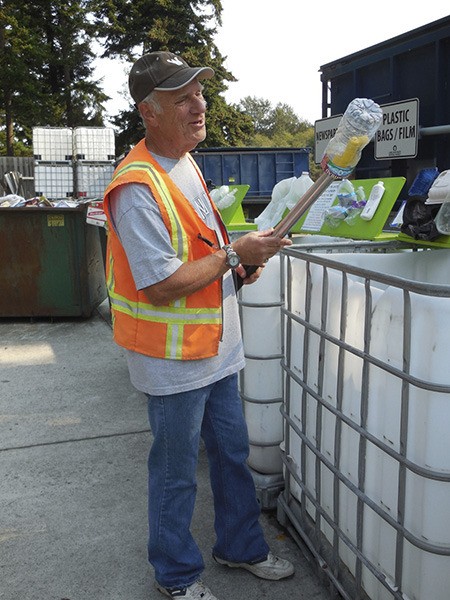
Page Read has a special message for anyone considering becoming a volunteer: “They provide a huge service to you and me, and I cannot thank them enough. If you can handle hard work, and you love your Dump, come and volunteer today. We have an orange vest in just your size.”
To volunteer, contact coordinator Carol Steckler at 468-2138, or sign up at www.lopezsolidwaste.org.