Chimera – weaving art, business and community
Published 6:13 pm Monday, August 6, 2012
By Iris Graville
Special to the Islands’ Weekly
No one disputes the intrepidness of the handful of Lopez Island artists who opened Chimera Gallery in 1987.
“We all wanted to make art, not run a business,” says Pamela Maresten, one of the co-op’s founders. Chimera’s business model – a worker-owned cooperative – eased their leap from art studios to ledger sheets.
“Putting your work in a regular gallery cuts into your earnings horrendously,” Maresten explains. “We preferred to trade our time to get a little more for our art. This was a way to make it go.”
The 25 candles on the anniversary cake at the Chimera Artists’ Cooperative annual meeting this year were proof that the approach has succeeded.
For potter Nancy Bingham, selling her art was a necessity back in 1987.
“I was trying to make a living through art and needed a place to show my work,” she says. “We were looking for venues and it seemed we had enough good art and good artists to put together a gallery.”
Although no longer active in Chimera, Bingham devoted herself to its first 10 years of operation.
“I liked the grass roots way we started things,” she says. “We made all those decisions about how to run it, the hours and what to call it.”
Bingham remembers much debate over “what to call it,” and the list of potential names that included Art Throbs Cooperative and Main Artery – A Cooperative.
“Nobody could pronounce Chimera,” Bingham says; Maresten, who’s credited with the moniker, recalls it barely got majority approval. Patrons still stumble over the word, even with the pronunciation guide on the cooperative’s business card (ki-meer-a) and definition (a thing of mixed character). But, it fit.
“This is exactly how it started,” Bingham says. “All these different people who had different ideas and different ways of doing things.”
Diana Bower, creator of the gallery’s logo, was among the founders and remains active today. Her linoleum block print – a fanciful griffin with the head of a lion, body of a goat, and long, curving tail – symbolizes the diversity of artists and personalities from the cooperative’s beginning through the present.
Maresten and Bingham recall that in those early days, gallery operations were, well, “of mixed character.” Members met often, and whoever showed up set the agenda and figured out who would facilitate and who would take minutes. There was no board of directors, and policies and procedures were fluid. Any artist who was willing to staff the gallery could join. Now an elected group of five oversees day-to-day operations and juries in new work, and a written contract delineates membership responsibilities and benefits.
Since the beginning, members have jotted notes in a journal during their shifts staffing the gallery, an 800-square-foot storefront just two doors from Holly B’s Bakery in Lopez Village. A leaf through the pages reveals this appraisal: “Soooo many people are here now, browse, browse, browse. If only we could live on compliments. It would be hard to make change though. Imagine trying to cash a standing ovation.”
For potter and founding member Jeffrey Hanks, joining the cooperative helped him view himself more seriously as an artist. One of his early gallery notes suggests working there wasn’t all serious, though: “I played music with a Friday afternoon mainland tourist guy.”
By the time the cooperative approached its 10th year, several of the original members had moved on, and enthusiasm (and sales) waned. There were murmurings of closing the doors. Part of the co-op’s key to success is its good fortune to pull in the right people at the right time. Gerry Gildea, a building contractor who also turns wood into bowls and spinning tops, sharpened his fellow artists’ skills at analyzing expenses and revenues.
Other newcomers such as potter Lydia Lukahnovich, painter and printmaker Sheila Simpson-Creps, studio jeweler Tina Finneran, and botanical artist Linda Ann Vorobik developed a schedule of monthly art openings, a website, an annual silent auction, and a student art show and scholarship fund.
“We do get too focused sometimes on the business aspect,” says Maxine Bronstein, board chair and fiber artist. “We have to make money to pay the bills, but any small business in a community like this is also a community service.”
Even as she scrutinizes the monthly financial reports, Bronstein acknowledges other returns on the cooperative’s efforts.
“There are so many customers who say it makes them feel good to come in and to see how people’s art is developing,” she said.
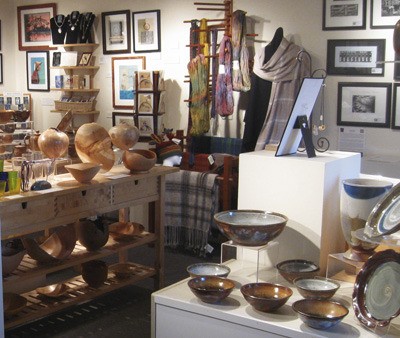
Step inside the gallery today and you’ll see work in a variety of media by the 22 members: paintings, original prints, hand-forged steel, glass, wood, fiber, paper, photography, jewelry, and clay. Seventy-two strips of paper dangle from a beam like a paper wind chime, each with the name of a current or past cooperative member; a four-foot long chart lists more detail about their years of participation. Many will join in a group show Aug. 11- Sept. 7 (visit chimeragallery.com for details).
Former members have shown work in the gallery throughout the anniversary year, including Maresten who brought in new paintings this spring.
“I totally appreciate the life of Chimera,” she says. “Its history is a part of the rich fabric of our community.”
– Writer and bookbinder Iris Graville joined Chimera Gallery in 2000.